About Me
- Lotus Reads
- Book fiend,culture-vulture, world traveller, daughter of the tropics now living in the Great White North.
Monday, November 06, 2006
 Hyphenated - Canadians
 Indian Minature Painting
of Mughal Woman

(The stamp depicts Laura Secord making her way
through the bush during her famous walk
to inform the British that the
Americans were going to attack Canada.)
through the bush during her famous walk
to inform the British that the
Americans were going to attack Canada.)
Today, 06 Nov, my family and I became official members of Canada, yes, we are now citizens of this wonderful country and the Great White North. Ofcourse, it's not everyday that people embrace a new country, infact, most people never do, so the impending event really had me thinking long and hard on what it was going to be like to swear allegiance to another country. In honor of the event I'd like to share something I wrote in April this year and maybe sometime later I will write another post on what it means to me to have embraced a different motherland.
*************
In July my family and I will celebrate our sixth year in Canada. Often people ask me if I have started to feel Canadian - I'd love to respond in the affirmative because it's almost like your adopted mother anxiously wanting to know if you love her - but the truth is, I feel more Indian than ever!
Don't get me wrong - I love my adopted country and I am loyal to it. I am grateful for all the opportunities it has provided me and my children and in return I will give it the best years of my life, but none of that changes who I am inside, for I will always be Indian. But my children, ahhh, that's another story. They are growing up Canadian; they speak perfect, unaccented English, they ski, they have pool parties, they speak French and do all the things Canadian kids do, except, unlike most Canadian kids, they have Indian parents!
So, when Friday comes around they accompany us to the temple. In March, we celebrate Holi (the festival of color) with our friends; they listen to Hindi music at home and watch Hindi movies (not always out of choice, I will admit, but because it is what my husband and I are watching and they are happy to join in); they eat curry and rice almost everyday of the week and best of all, spend every second summer in India. What does that make them? A few years ago saying they were Indian-Canadians would have seemed unpatriotic, but these days it seems everyone is happy to embrace their hyphenated identities, so I say it with pride: my kids are Indian-Canadians!
What sparked this post? An article by Jhumpa Lahiri ( Pulitzer prize winning author of "Interpreter of Maladies" and "Namesake") in the recent issue of Newsweek. She explains with candor and insight what it was like for her to grow up with two identities, working hard all the time to merge them into one and the effect it has had on her life. The last paragraph of the article is particularly poignant.
Wednesday, November 01, 2006
Santhara
Death is not a topic everyone is comfortable reading about or discussing, so I won't be at all offended if you don't read or comment on this post.
I'm sure everyone has heard of the barbaric Indian custom of Sati - the immolation of a widow on her husband's funeral pyre- which was outlawed in 1886 and I'm sure all of us who live in this day and age heave a sigh of relief that these practices no longer take place, but what if I were to tell you that while Sati might be outlawed the practice of "Santhara" is still alive and thriving? So, "what is Santhara" I hear you ask. Santhara is a Jain custom where a person upon deciding that he or she has had enough of this world takes up a fast unto death. While suicide and euthansia continue to remain against the law, apparently Santhera is permissable, begging the question, what is the difference between Santhara and Euthanasia or Santhara and suicide?
Apparently, The Shwetambar sect of the Jain community condone the practice because they claim it is the ultimate spiritual achievement, but sociologists do not agree for the simple reason that it is mostly women who undertake the fast. They (the sociologists) think the practice is sexist and that like the widows of Varnasi, these poor widows of Rajhastan (the state in India where the highest number of "Santaras" take place) are cajoled and sometimes forced to fast unto death by attaching religious glamour to what they are about to do.
In the last one week five cases of Santhara have been reported in Rajasthan, of which two people have died. Annually, over 200 Jains embrace death every year. Isn't it time someone took some action?
I wonder if I have any Jain readers - I would love to ask them what they think of this religious practice.
Saturday, October 28, 2006
Gautam Malkani taught me what a Desi is!


Sasgirl pointed me to a really informative article recently. The article had to do with Gautam Malkani's book "Londonstani" which incidently has somewhat of a cult following among the South Asian community in London and to a smaller extent, here in Toronto ( the book and I had to part ways after about 50 pages because I just couldn't get used to the lingo, but for the readers that persisted the book was a rewarding read indeed).
Anyway, in a nutshell, Malkani's novel revolves around a gang of desi rude boys in London, England who are prone to cellphone scams, beating up white kids who call them "Paki," and obsessed with bling, bodybuilding and girls. Now, how is that different from any other gang of street kids one might be tempted to ask...what's different is that initially immigrant East-Indian kids followed a certain stereotype: we were all studious, conscientious, timid...almost subservient. Then, according to Malkani, in the early '90s, we were not only rejecting that, we were morphing into something aggressive and embracing gangsta rap and asserting our ethnicity in OTT (over the top) ways.
Malkani explains, and I paraphrase, that minority (Indian) communities find it difficult to integrate quickly and effortlessly, so, they may do just the opposite, that is voluntarily isolate themselves from other communities, trying to build up their self-esteem and identity so that when they reintigrate into society later on, they do so from a position of strength and on their own terms. They no longer integrate by trying to be like the predominant culture (in the case of Londonstani, the British) . With their East-Indian backgrounds and culture they know they are different and whereas they once feared that, they now embrace it. This has provided a new definition of Britishness or American-ness, as the case may be. The result is what is termed as Desi subculture- a fusion of South Asian and the mainstream, in everything from food to music to clothing.
According to Malkani, the word “desi” literally means countrymen and refers specifically to the diaspora of the Indian subcontinent. It is broader than terms such as Indian, Pakistani, Hindu, Sikh or Muslim, and yet narrower than the term Asian or even South Asian. It acts as a self-determined alternative to the word “paki” and the enthusiasm with which it has been embraced suggests a conscious decision against appropriating the offensive word paki and trying to turn it into a positive the way black kids have done with the word “nigger”.
Last year, “desi” appeared as a noun in the Oxford Dictionary of English, having been first introduced as an adjective in 2003. Meanwhile, mainstream media outlets have employed it
for programming - such as the BBC’s Desi DNA show - and even an entire channel in the case of MTV Desi. There is also the Desi-Lit book club of which I am a proud member!
All this semantics is important because, as a result of the word’s development, desi is now closer to the term “latino” than “Hispanic”, and it has come to refer to a loose subculture rather than a rigid ethnicity.
So, are all Indian expats desis? I don't think so. To me, a "desi" is a person of Indian origin, living outside of India and embracing all things Indian. For instance, I have a lot of Indian friends here in Canada who are, by their own admission, "coconuts" - brown on the outside, white on the inside. They could not and would not like to be considered Desis.
What does being Desi mean to you?
Wednesday, October 25, 2006
Batting my eyelashes!

FINALLY, a cosmetic enhancement I might be tempted to try!!! OK, I'm kidding, but longer lashes is always a good thing, isn't it?
Culled from CNN/IBN:
"DO you think you've seen it all when it comes to cosmetic surgery? Look more closely.
Eyelash transplant surgery wants to become the new must-have procedure for women -- and the occasional man -- convinced that beauty is not so much in the eye of the beholder as in front of the eye itself.
Using procedures pioneered by the hair loss industry for balding men, surgeons are using "plug and sew" techniques to give women long, sweeping lashes once achieved only by glued on extensions and thick lashings of mascara.
And just like human hair for that is the origin, these lashes just keep on growing.
"Longer, thicker lashes are a ubiquitous sign of beauty. Eyelash transplantation does for the eyes what breast augmentation does for the figure," said Dr Alan Bauman, a leading proponent of eyelash transplants.
"This is a brand new procedure for the general public (and) it is going to explode," Bauman said during what was billed as the world's first live eyelash surgery workshop for about 40 surgeons from around the world.
Under the procedure, a small incision is made at the back of the scalp to remove 30 or 40 hair follicles that are carefully sewn one by one onto the patient's eyelids.
Only light sedation and local anesthetics are used and the cost is around $3,000 an eye.
The technique was first confined to patients who had suffered burns or congenital malformations of the eye.
However, word spread and about 80 per cent are now done for cosmetic reasons.
For many women, eyelash surgery is simply an extra item on the vast nip-tuck menu that has lost its old taboos.
More than 10 million cosmetic procedures from tummy tucks to botox were performed in the United States in 2005, according to the American Society of Plastic Surgeons.
The figure represents a 38 per cent increase over the year 2000.
Twenty-seven year old Erica Lynn with long auburn hair, breast implants and a nose job, had eyelash transplants three years ago because she was fed up with wearing extensions on her sandy-colored lashes.
"When I found out about it, I just had to have it done. Everyone I mention it to wants it. I think eyelashes are awesome. You can never have enough of them," Lynn said.
Bauman, who practices in Florida, does about three or four a month. Dr Sara Wasserbauer, a Northern California hair restoration surgeon, says she has been inundated by requests.
"I have been getting a ton of eyelash inquiries. If I had $10 for every consultation, I'd be a rich woman,” she said.
The surgery is not for everyone. The transplanted eyelashes grow just like head hair and need to be trimmed regularly and sometimes curled. Very curly head hair makes for eyelashes with too much kink."
I do realise that "eyelash curling" might seem a frivolous topic to post about, but in doing so, I'm trying to get an opinion on cosmetic surgery in general...would you do it? Do you think it betters a person's chances of getting a good job, a great date? Does it improve one's self-confidence? Or is cosmetic surgery a dangerous obsession? What fuels it? Why, as a society, are we creating a standard of beauty that is artificial, that doesn't even exist in nature? Why?
Sunday, October 22, 2006
3 Thingy's :An All About Me Meme

3 Thingy’s: a Friday Meme
(hope no one minds my doing it on a Sunday!)
3 things that scare me:
Global Warming
Driving through a snowstorm (and goodness knows we get our fair share in Canada)
Rats!!!
(hope no one minds my doing it on a Sunday!)
3 things that scare me:
Global Warming
Driving through a snowstorm (and goodness knows we get our fair share in Canada)
Rats!!!
3 people who make me laugh:
My kids
Russel Peters
George W.
3 things I love:
A girl's night out (don't get too many of those anymore unfortunately)
One on one time with my daughters
A good book!
The fragrance of sandalwood (oops, that's 4!)
3 things I hate:
Braggarts
Insincerity
A lack of curiosity
3 things I don't understand:
Sci Fi
Calculus
Taxes (told you, Melissa ;)
3 things on my desk:
A ton of journals
photographs (not framed)
coffee cup
3 things I'm doing right now:
Looking at my desk wondering which kid I can pay to tidy it up!
Thinking about getting another cup of coffee
Getting ready to talk to my mom in India
3 things I want to do before I die:
Go back to India on a sabbatical
A stint as a reporter, a journalist or both
Work for a while with Global Volunteers
3 things I can do:
Strike up a conversation with just about anyone
Play the piano
Read Arabic
3 ways to describe my personality:
I'm curious about everyone and everything
Friendly
Highly empathetic
3 things I can't do:
Exercise at the gym (it bores me stiff)
Public Speaking
Change a car tire
3 things I think you should listen to:
Russel Peters
NPR
and
ME! :)
3 things I think you should never listen to:
Your naysayers
Rumors
Negative people
3 favorite foods:
Coconut curry
Green gram payasam
Mangoes (yeay, Beenzzz)
3 things I'd like to learn:
To paint with oils
Web designing
Conversational French
3 beverages I drink regularly:
Water
Vo8
Coffee
3 shows I watched as a kid:
Mind your Language (A British Comedy Serial)
The Jeffersons
Three's Company
Not sure who to tag, not too many people read this blog.
Shelliza, have you been tagged yet?
Anocturne, would you like to do this?
Sruthi, how about you?
Wednesday, October 18, 2006
Diwali दीवाली
 Tomorrow is the start of my favorite festival of all time -Diwali or the Festival of Light, so named because of the tradition of lighting lamps all over the house and outside the house, too!
Tomorrow, the 19th, is called Dhanteras, the birthday of Lord Dhanwantari, the god who according to Hindu mythology, grants immortality. People generally buy new utensils or metal objects as auspicious items which they believe will ward off evil and ill health for the rest of the year and bring peace and prosperity. Tomorrow is also the birthday of God Yam, the god of death and lamps will be kept lit througout the night in respect to Him thus hoping to prevent untimely deaths!
Oct 20 is "Chhoti Diwali". Again, we will have lamps and little "diyas" lit all over the house and along the walkway leading to the house. The kids will paint "rangoli" designs on the front porch and light pathakas (firecrackers), eat sweets and have lots of fun!
 |
Rangoli picture courtesy Sandhya Jain
Oct 21 is DIWALI! After dusk we will have the Lakshmi Puja, seeking wealth and prosperity for the whole year. This is the evening we cook a feast, invite friends over, light more pathakas, exchange sweets and play cards until the wee hours of the morning! :)
Oct 22 will be a quiet day
Oct 23 is "Bhai Dooj". This day is observed as symbol of love between sisters and brothers....sisters apply "tika" (dot) on their brother's forehead and receive gifts and blessings in return. I don't have a brother so I guess I won't be celebrating Bhai Dooj.
For some fabulous Diwali detail please visit the incredibly talented FoodiesHope blog!
Tuesday, October 17, 2006
A day in someone else's shoes, ok, veil...
 The Guardian (UK) has an article this morning about an English (Muslim) journalist who wore the hijab (veil) for a day. "...she was shocked by how it made her feel - and how strongly strangers reacted to it"...
Although the article was more about her reactions to seeing herself in the veil and less about the people she encountered, I couldn't help but be fascinated by her attempt to understand what it actually feels like to be a veiled woman.
This reminds me of the time Oprah had two white man volunteer, with prosthetics, make-up and the whole shebang, to pose as black men.. it is only when they spent time in a black man's skin did they understand the daily problems and prejudices they faced. I remember so distinctly one of them telling Oprah how he could never get a cab, because no one would stop for him, not even a fellow African-American driver. I guess there are always a few life lessons to be learned when we spend time in someone else's skin. I think it makes us less quick to judge people and less fearful of people we perceive as being different from us...
Read more from the Guardian here
Thursday, October 05, 2006
For Love's Sake?
 My dad sent me this article from the Times of India - I read it and my jaw dropped to the floor. Surely, this is isn't love, but a very flawed idea of it.
Monday, October 02, 2006
Where in the World is Anthropologist ?
 Shimmering silks, glittering jewels, doe-eyed maidens, the sound of feet tapping and bells jingling, hennaed hands, beautiful tabla beats -where in the world was I this time?
Give up? We were at the terrific Harbourfront Dance Festival also known as the Kalanidhi Dance Festival. I went with friends Mukta and Rehana and we were very lucky to witness two of India's very popular dance styles, the "Kuchipudi" and "The Odissi".
The Kuchipudi , which hails from the state of Andhra Pradesh in India, is one of India's seven main classical dance styles and although very similar in style to the better-known Bharat Natyam, the movements tend to be more fluid and the pace is faster. The Kuchipudi dance began as devotional enactments to the life of Lord Krishna and were performed exclusively by men. However, over the last 50 years the dance has undergone a revival and is now performed on the modern stage around the world by both men and women One of the highlights of the Kuchipudi dance is when the dancer dances on the rim of a brass plate - I don't know how to describe it except to say that as a feat it is jaw dropping and aesthetcally it is mesmerizing. I hope you all can treat yourselves to a Kuchipudi recital some day.
Look here for some wonderful Kuchipudi pictures.
The performers last evening are known as the Kuchipudi Dance Collective,do visit their website for a look-see.
 |
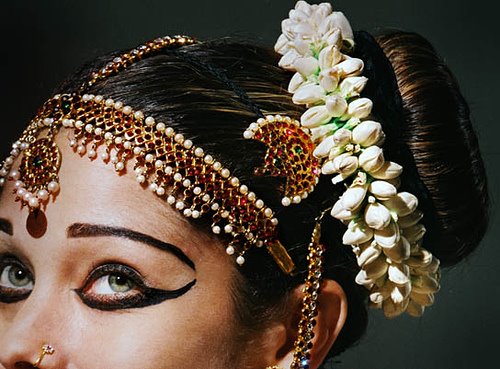
Odissi Dancer
Next we were bedazzled by the Orissa Dance Academy with their lively, colourful and enchanting performances of the Odissi dance. The Odissi probably originated as a temple dance and this particular program we were privileged to see had many components to it, my favorite one (only because it is a dance trend heading for oblivion) was the Gotipua Dance, performed by young boys (usually under 8 years of age) dressed in female attire. The Gotipuas lead a life of vigorous training under the supervision of their gurus. These are usually poor kids dedicated to the temple by parents who either cannot afford to look after them or because they have vowed to sacrifice a child in exchange for a boon like good health, etc. These little dancers are never allowed to go back home, not even to perform a parent's last rites -once they are given up they become the sole responsibility of the guru (the teacher). They undergo vigorous training, learning to bend and twist their bodies to strike acrobatic poses -one has to see a performance to believe what these little dancers are capable of.
Here are some pictures of Odissi dancers.
Sunday, September 17, 2006
Movie Review: Abeni (2006) Nigeria
 Actors: Sola Asedeko, Amzat Abdel Hakim, Jide Kosoko, Aboh M.
Akinocho, Kareem Adepoju, Moufoutaou Akadiri, Idowu Philips, Bukky Wright
Director: Tunde Kelani
Release Date: 2006 April
Language : Yoruba with English subtitles
Watch out Hollywood and Bollywood, for there's a new kid in town! Its name is Nollywood, it hails from Nigeria and is all set to take this neighborhood by storm! It's true, Nollywood or the Nigerian film industry is one of the largest in the world today and poised to get bigger. According to the Guardian.UK : In Nigeria, the average film costs between £10,000 and £15,000, is shot on video in about a week, and released into a bustling market where 100,000 videos are sold in one morning.
Nigeria is a young democracy (about 6 years old) and making videos or movies is one way for young Nigerians to tell their stories after years and years of having no freedom of speech. Last night, at the TIFF showing of "Abeni" Tune Kileni, the director, informed us that there are atleast 50 new releases in Lagos every week! If that's true, Nollywood sure leaves Hollywood and Bollywood in the mud!
Coming back to Abeni, although it was the toast of Africa at the film festival, to me the story lacked depth and conviction and the cinematography lacked the slickness of Bollywood. From the sets, the acting. the horrible canned music playing in the background right through the movie and the quality of production, I would have preferred to have it classified as a home-made movie.
Like I said, the story lacked depth, but after talking to a couple of regular Nigerian- film goers I have concluded that most Nollywood films are about young people going to university, rich people having affairs (a la our mid-morning soap operas on the idiot box) or films about rich girl marrying poor boy and getting hell from the parents because of it. I guess, what I am trying to say is that, the industry is not big on social issues, they prefer pot boilers with cliffhanging endings, however, Abeni was worth watching because it showcases the unique Yoruba culture that flows between Nigeria and Benin.
Let me include a short synopsis from Rotten Tomatoes:
Abeni (Sola Asedeko) is a beautiful, ambitious young woman born to a rich father. Akanni (Abdel Hakim Amzat) is a handsome young man who has pulled himself up from poverty. When he was a child, his father worked for Abeni's father and the children were sweethearts, but Akanni's recklessness led to his whole family relocating across the Nigerian border to Cotonou, in Benin. When Abeni and Akanni meet by chance as adults, their romantic fate is sealed. He is already engaged and she is set to be married off by her father, but this couple has other plans.
Friday, September 15, 2006
Acid Attacks on Women in the Subcontinent

Right across the road from my mother's childhood home there lived a family with two daughters in their twenties. I was at the age when one tends to idolize girls older than oneself and so, whenever I went to visit my grandmother I would spend hours admiring these two Anglo-Indian sisters with their honeyed eyes and golden-brown hair. Shortly after my 10th birthday I noticed that the older girl had dropped out of sight. After many weeks had gone by, I asked my grandmother why Rivalli* was nowhere to be seen and she told me (my grandmother was not one to mince words) that Rivalli's boyfriend had thrown acid on her face in a fit of jealous rage. Being only 10 years of age, I didn't know the damage that acid could cause so imagine my shock when I saw Rivalli several months later to find half her face had been eaten away by the acid and she had a permenant limp owing to damage caused to her feet by the acid.
Sadly, I would go on to meet and know a couple of other women who were victims of acid attacks. Whilst in High School, two of my classmates were also victims with one of them losing an eye due to the corrosiveness of the acid. The Indian newspapers were full of sad stories of young men who would resort to acid throwing when they felt spurned by the object of their affection. I read recently that such cases are also very common in Pakistan and Bangladesh. Infact, in Bangladesh, acid throwing is so prevalent that they even have a special hospital and rehabilitation centre for victims.
So, I found myself wondering why some men use this cruel method to exact revenge on a lover who has spurned his attentions and why acid-throwing happens to be a favored measure of retaliation for men from the sub-continent but hardly found elsewhere?
Let's try and tackle these questions together- I think one of the big reasons men in the subcontinent favor acid-throwing is because acid is cheap and easy to buy here. Sure, there are regulations on the sale, use, storage etc., but the rules are lax, also, in the male-dominated societies of the sub-continent, the man loses face when rejected and so he wants the woman to lose face, too, pun intended. Statistics tell us that women who have been left scarred or disfigured in an acid attack seldom ever get married, they are ostracized by their family and friends and are unable to find jobs. Their lives are all but over.
So, the next time the world celebrates an International Woman's Day can I ask all of you to remember the victims of acid attacks? True, in most cases their lives are spared, but because they are shunned so much by society I am sure a lot of them wish they were dead.
* Names have been changed.
Friday, September 08, 2006
Incha Allah Dimanche (2001) - a review and a rant

In the aftermath of World War 2, France attempted to replenish its weakened work force by recruiting men from North Africa, in particular, Algeria. In the mid-1970’s, the French government relaxed its immigration policy to allow the families of Algerian men to join them. INCH ALLAH DIMANCHE provides us with a deeply moving memoir of the sense of isolation and vulnerability that the immigrant family experienced upon their arrival at a time when racial integration was virtually non-existent.
I found this movie extremely moving and it's no doubt because I could identify with the main character, an Algerian wife and mother, Zouina who was forced to leave her family and friends behind in Algeria to join her husband in a country that was so alien and unfriendly to her. She is so lonely that the minute she hears of another Algerian family in the neighborhood she plots (her husband doesn't like her to leave the house) to go visit them. When she does find the family she is greeted warmly enough, but the minute the lady (Mallika) realizes that Zouina is there without her (Zouina's) husband's permission, she goes ballistic and throws her out the door. This scene might seem overdone and highly dramatic to a lot of viewers, but many immigrants, after they move to a new country, seem to enter a time warp. They do not keep up with the times and the changes in their home country and are thus far more traditional than their people back home. To simplify, I find some of the Indians I meet in Canada hold the traditions and values that people in India held over 20 years ago. It can be quite weird!
Last year in Toronto there was a spate of suicides among young women from Vietnam and Sri Lanka( the motivating factor, the medical people say, was depression). Upon further investigation it was found that the one common thing between these women is that they were all recent immigrants! Something more needs to be done to make integration easier for these young men and women that come from countries so different from their host countries. In our globalized world, immigration and relocation is not just beneficial to the immigrant but also to the host country ( a lot of countries in Europe have an aging and negative growth population and are in desperate need for young families). Immigrants bring in a lot of money, young blood and important and much needed work skills. It is our responsibility to see that they feel welcome and are able to integrate quickly and painlessly. I am sure well-meaning people will point out the scores of organizations (charitable and government- run) that help with integrating immigrants, but it's not enough to just teach them English and give them a set of skills, we need to to have social programs where they can meet people who have the potential to be "friends" to these people. Loneliness can be a terrible thing. While work is fine, what gets these people is their inability to meet and socialize with people in the long evening hours or on the weekends.
I do apologize for the rant but this is a cause that is very close to my heart. I have contacted the appropriate authorities and have volunteered to set up a social program - they have promised to "look into it". This was 2 years ago.
But to return to the movie, it is a splendid effort with each of the actors (children included) playing their part to perfection. I have read that this award-winning film is based on director Yamina Benguigui's own experience growing up as the child of immigrant parents amid the tumult of Arab assimilation and the women's rights movement in France. The music is Algerian and hauntingly beautiful and I will miss not being able to listen to it on a CD. I will not miss seeing the hideous furniture and wallpaper from the '70's however!
Monday, August 28, 2006
Festivals of India: Ganesh Chaturthi

Yesterday was the start of the wonderful festival of Ganesh Chaturthi in India. My childhood memories of this festival consist of eating modaks, admiring the beautifully decorated clay idols my friends would install in their shrines and then, running up to the terrace in the evenings to watch the procession as devotees take their idols to the sea for immersion. What follows below is a slightly more detailed version of what Ganesh Chatruthi is all about from About.com:
A life-like clay model of Lord Ganesha is made 2-3 months prior to the day of Ganesh Chaturthi. The size of this idol may vary from 3/4th of an inch to over 25 feet.
On the day of the festival, it is placed on raised platforms in homes or in elaborately decorated outdoor tents for people to view and pay their homage. The priest, usually clad in red silk dhoti and shawl, then invokes life into the idol amidst the chanting of mantras. This ritual is the pranapratishhtha. After this the shhodashopachara (16 ways of paying tribute) follows. Coconut, jaggery, 21 modakas (rice flour preparation), 21 durva (trefoil) blades and red flowers are offered. The idol is anointed with red unguent (rakta chandan). Throughout the ceremony, Vedic hymns from the Rig Veda and Ganapati Atharva Shirsha Upanishad, and Ganesha stotra from the Narada Purana are chanted.
For 10 days, from Bhadrapad Shudh Chaturthi to the Ananta Chaturdashi, Ganesha is worshipped.
On the 11th day, the image is taken through the streets in a procession accompanied with dancing, singing, to be immersed in a river or the sea symbolizing a ritual see-off of the Lord in his journey towards his abode in Kailash while taking away with him the misfortunes of all man. All join in this final procession shouting "Ganapathi Bappa Morya, Purchya Varshi Laukariya" (O father Ganesha, come again early next year). After the final offering of coconuts, flowers and camphor is made, people carry the idol to the river to immerse it.
The whole community comes to worship Ganesha in beautifully done tents. These also serve as the venue for free medical checkup, blood donation camps, charity for the poor, dramatic performances, films, devotional songs, etc. during the days of the festival.
Sunday, May 21, 2006
Ushpizin (Hebrew movie) 2004
I had the good fortune to watch "Ushpizin"(meaning Holy guests),a truly heart-warming Israeli comedy, and I have come away with the greatest respect for the Hasidic Jews and the good and holy lives they are intent on leading.
Here is the synopsis from Odeon Films:
Moshe (Shuli Rand) and Mali (Michal Bat-Sheva Rand), a poor and childless Orthodox couple, find themselves penniless on the eve of the Jewish holy day of Succoth (the temporary dwellings religious Jews stay in during the festival to commemorate the time of the Exodus, and remind the devout that this life, too, is temporary.) They pray for assistance from the Lord and the impossible happens : Moshe and Mali are the beneficiaries of an unexpected charitable donation. God has taken pity on them, or so it seems, until two escaped convicts show up on their doorstep. Worried the visitors may be messengers of God, the couple follow the custom of receiving guests for the holy day and extend their hospitality. They soon learn God works in mysterious ways as their faith is put to the ultimate test when the convicts bring chaos into their gentle community. Offering an authentic and unique look at the inside of the Orthodox Jewish world, Ushpizin, is a heart-warming and humourous drama exploring the powers faith.
According to variety.com, this movie was groundbreaking in its sympathetic insider depiction of Jewish ultra-Orthodox Jerusalem and it represents the first collaborative effort between Israel's religious and secular communities (Critically acclaimed Israeli actor Shuli Rand, who gave up his wildly successful career to return to religion nine years ago, wrote the script and plays Moshe). The ultra-orthodox don't go to the movies, let alone participate in productions, but Shuli Rand's participation in the movie, with the agreement of his rabbi, meant us having an authenitc look at the Hasidic Jews. Stipulations on release included no screenings on the Sabbath; many religious Jews illegally downloaded the movie from the web rather than go to the cinema at all, leading to a rabbinical e-plea that all felonious perps should send money to the production company as compensation.
I have always been fascinated by the Haredi or Ultra-Orthodox Jews. Sure, there are other groups in the world that hem their members in with many restrictions, like the Hutterites and Mennonites in North America, and then, there's Iran and the Wahabi sect of Saudi Arabia, but what makes the Haredi Jews so unique is they are carrying on their fierce cultural war right in the midst of secular life, in busy metropolitans like Jerusalem, New York and Tel Aviv. Also, their numbers are growing rapidly because of their high birth rate and the extremely low drop-out rate among their children. Although I'd like to be open-minded about their beliefs, from what I have read, so much of their thinking is based on nothing superstition. Also, according to Bronwyn Drainie's book "My Jerusalem" many of them are obsessed with a form of "knowledge" known as gematria, which is an elaborate number game played with the letters of the Hebrew Alphabet.
This is a review in progress...
Thursday, May 11, 2006
Have you eaten mangoes naked?

It is raining here today, I'm afraid. But, I hail it as a welcome relief from the very warm days we have been having oft late. I don't mind that it is warm but it seemed much too warm for so early in the season. I heard somewhere that this summer is going to be merciless - news like that makes me want to go Arrrrrrrrrrrrrrrggggggggh!
Now, in India we atleast have something that compensates for the long, humid summers - it's a shiny, warm-to-the-touch golden-orange oval ball of delight that fits comfortably into one's palm. Its skin is as smooth as a baby's bottom and its fragrance is sweet and mild (unlike a baby's bottom, :)). I'm sure you've guessed what it is I am referring to - it's the King of Fruits, the Mango! We were in Brampton (the abode of a large majority of Ontario's Sikh community) last night and we saw a vendor selling mangoes @ 6 for $18 . We grabbed them and I had my first mango of the season for dessert! I have so many "mango memories" as a child. Mango being such an intrinsic part of summer, it's hard to separate the two. It's a pity my kids won't ever experience a mango summer.
 |
 |
(pic courtesy: Mumbaimetblogs.com)
When we were kids we'd have mango for breakfast, lunch and dinner. We'd eat them cubed, sliced, suck the pulp straight out of the fruit with our mouths, or as "aamras" (a pulpy juice that mom would make) with puris to scoop them up with; we'd eat them anyway we got them. There was no stopping us, little Mango monsters that we were! Mango gluttony, however, did produce what is known as "mango boils" - little puss-filled eruptions all over the body. But that was just a small price to pay for the joy of slurping those juicy mangoes.
 |
I can go on and on singing a paean to mangoes, but unless you try the nectar, or should I say ambrosia, of one of those Alphonso mangoes you might never fully imagine my obsession with them. However, if you haven't had enough, feel free to read the wonderful NYTimes article on Mango Mania in India.
In closing, all I have to say is that the theologians of the Bible probably got their fruits mixed up - I feel certain in my gut that Eve tempted Adam with the mango.
Monday, May 08, 2006
Shhh, don't Look Now, I'm Changing!!!

Trying to acquire a new look for my blog - I will be back, don't go anywhere!
Sunday, April 02, 2006
What the...

I thought judging people,races or nations based on IQ scores was now passé? Maybe even politically incorrect? But "The Sunday Times" reports that a new European league of IQ scores has ranked the Germans right on top with an IQ of 107, followed by the Netherlands, Poland, Sweden, Italy, Austria and Switzerland.
One of the explanations put forward by Prof. Richard Lynn of the University of Ulster is this:
"... populations in the colder, more challenging environments of Northern Europe had developed larger brains than those in warmer climates further south. The average brain size in Northern and Central Europe is 1,320cc and in southeast Europe it is 1,312cc. “The early human beings in northerly areas had to survive during cold winters when there were no plant foods and they were forced to hunt big game,” he said. “The main environmental influence on IQ is diet, and people in southeast Europe would have had less of the proteins, minerals and vitamins provided by meat which are essential for brain development.”
So, folks, once and for all, it is "geography" and not "genes" that contributes to the success of a nation!
Although the article is geared more towards the British reading public, it makes for quite an interesting read for all of us.
Tuesday, March 28, 2006
TLC's "Little People, Big World"
TLC's "Little People, Big World" is making waves among the viewing public in North America. They portray the everyday lives of the Roloff family. Matt and Amy Roloff are in their mid-40's and both are dwarfs or little people. They have four children, just one of whom is a "little person".
What I would like to know is this: Is "Little People, Big World" a legit excuse for voyeurism into a dwarf's world, or is the show really helping to educate people about dwarfs and dwarfism?
Will we allow little people to truly live "normal" lives doing everyday things like most of us? Or will we continue to gawk at them making them feel that their physical differences do separate them from the rest of us?
Finally, I would love to read some books on dwarfism, so if anyone has any titles to suggest, please pass them on.
Monday, March 06, 2006
SABAH, The Movie.
While everyone else was watching the Oscars, I watched "Sabah, the movie" instead. Here's a short synopsis: It's about a 40-year old Syrian woman who lives in Canada. Sabah has never married because, after her father died, she allowed herself to fall into the role of her mother's caretaker while her brother took over as head of the household, ruling all the women in his family with an iron fist.
I guess, this being a movie, one has to forgive the stereotyping, but Sabah is the kind of woman who would just cower under the glance of a man, so firmly embedded in her cultural consciousness is the expectation that a woman is never seen to do anything that would seem provocative and that includes, never having a bare head, never looking a man in the eye, never giving him the "come on" even inadvertently. Anyway, one day, Sabah does something radical - she goes swimming!!! She is usually the lone swimmer in the gym pool until one day a man joins her and accidently uses her towel when he gets out to answer a call on his cell phone. When Sabah goes to reclaim her towel it sparks off a highly unlikely friendship between the two which leads to a wonderful romance, at once bashful and passionate. Unfortunately, because he's a white man and a Christian, Sabah cannot let anyone in her conservative Muslim family know about her boyfriend...obviously I cannot tell you what happens next because that would amount to a "spoiler" and I would hate to be accused of that, what I can tell you however, is I would have called this movie, "A 40-year Old Virgin-2"!
Seriously though, this is a wonderful movie where culture and romance are conflicted - makes you so appreciative of how falling in love is so uncomplicated in the western world, or is it?
While everyone else was watching the Oscars, I watched "Sabah, the movie" instead. Here's a short synopsis: It's about a 40-year old Syrian woman who lives in Canada. Sabah has never married because, after her father died, she allowed herself to fall into the role of her mother's caretaker while her brother took over as head of the household, ruling all the women in his family with an iron fist.
 |
Seriously though, this is a wonderful movie where culture and romance are conflicted - makes you so appreciative of how falling in love is so uncomplicated in the western world, or is it?
Wednesday, March 01, 2006
Apparently blondes have been having fun since the end of the "Ice Age"
A new study has found that north European women evolved blonde hair and blue eyes at the end of the Ice Age to make them stand out from their rivals at a time of fierce competition for scarce males.
According to the article in "Evolution and Human Behavior", "...blond hair originated in the region because of food shortages 10,000-11,000 years ago. Until then, humans had the dark brown hair and dark eyes that still dominate in the rest of the world. Almost the only sustenance in northern Europe came from roaming herds of mammoths, reindeer, bison and horses. Finding them required long, arduous hunting trips in which numerous males died, leading to a high ratio of surviving women to men.The increase in competition for males led to rapid change as women struggled to evolve the most alluring qualities. Peter Frost (a Canadian anthropologist) believes his theory is supported by studies which show blonde hair is an indicator for high oestrogen levels in women..."
Now we all know that celebrity blondes such as Marilyn Monroe, Jessica Simpson, Reese Witherspoon and Paris Hilton are held up as ideals of feminine allure. However, the future of the blonde is uncertain.
A study by the World Health Organisation found that natural blonds are likely to be extinct within 200 years because there are too few people carrying the blond gene. According to the WHO study, the last natural blond is likely to be born in Finland during 2202.
Subscribe to:
Posts (Atom)